
3 Proven Strategies To Reduce Hiring Costs
Hiring costs continue to increase substantially year after year as job search platforms like Indeed and LinkedIn become oversaturated with companies seeking the right talent. With competition for top talent at an all-time high and the labor market at full capacity, reducing hiring costs is challenging unless you analyze the complete employee lifecycle.
The problem is that most companies only look at hiring data to reduce costs, rather than integrating candidate quality and retention data into the equation. Below, we provide three strategies to reduce hiring costs with visualization examples of each in action.
1. Analyze Quality Hire By Recruiting Source
One strategy to reduce hiring costs is to analyze quality hires by recruiting source. This is especially effective for companies with multiple recruiting channels and candidates from various sources. The Quality Hire metric can be measured in different ways, such as performance KPIs, tenure, or a combination of both.
This approach helps reduce hiring costs by identifying the most effective sourcing channels for attracting top talent, allowing you to allocate your budget more efficiently toward recruitment sources that produce higher-quality candidates. The more effectively you allocate hiring resources, the less you’ll spend on recruiting, ultimately reducing hiring costs.
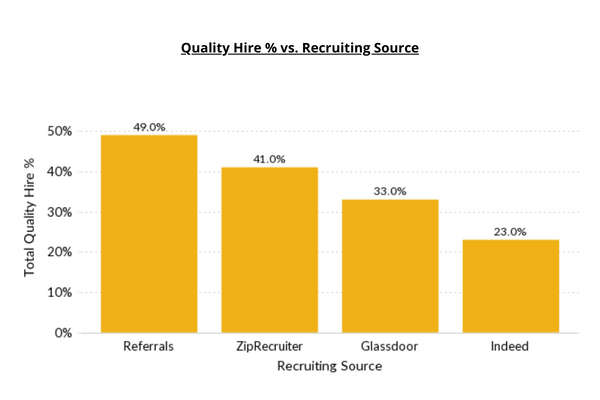
In the example below, you’ll see the quality hire percentage by channel for a customer service role. The data shows that the two best sources for this role are referrals and Glassdoor, while Indeed and ZipRecruiter produce fewer quality hires. Knowing that referrals and Glassdoor yield better results, you can allocate more budget to these channels. In the case of referrals for this role, it may even be worth increasing incentives to bring more candidates into the funnel.
2. A/B Test Job Post Copy & Formatting
Another strategy to reduce hiring costs is A/B testing job post copy and formatting. Optimizing the copy and format of your job posts can lower your cost per applicant and increase the quality of applicants. Some areas where A/B testing can be effective include job post length, keywords, and style.
A/B testing is commonly used in marketing to optimize advertising campaigns by comparing two versions to see which performs better. Similarly, testing job posts allows you to determine which copy and format are most likely to reduce hiring costs.
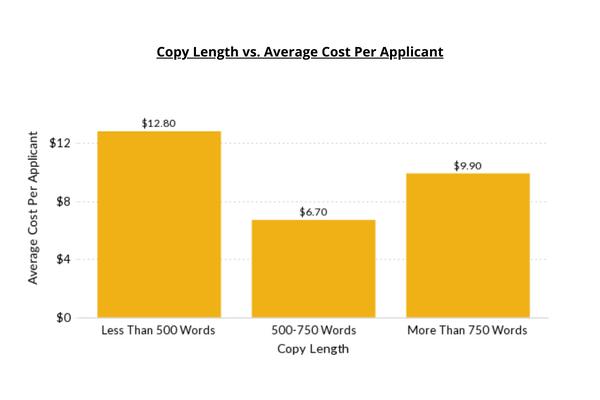
In the example below, you’ll see the difference in copy length for the same job listing versus cost per applicant. The data shows that the job listing with 500-750 words performs better than both the shorter and longer versions.
3. Build Ideal Candidates Profiles With Data
A third strategy to reduce hiring costs is to build ideal candidate profiles based on data. This exercise can help reduce hiring costs for several reasons. First, it allows you to understand, based on historical performance and hiring pipeline data, what leads to better quality hires.
Second, it enables you to integrate behavioral data into your ideal candidate profiles, enhancing your job posts with keywords that attract the right candidates. Third, it allows your hiring team to operate more efficiently by focusing on candidates who meet a proven set of criteria for success in the role.
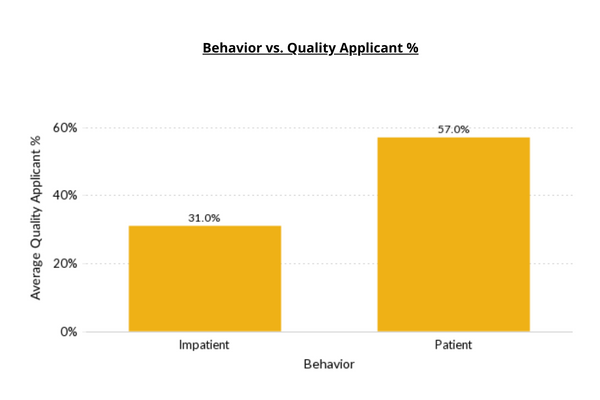
In the example below, you’ll see the difference in quality applicant percentage for engineering candidates who possess either patient or impatient behaviors. Data shows that candidates with patient behaviors have a higher hiring success rate. With this insight, you can add “patience” as a keyword in your job posts, which may help lower the cost per applicant and increase your quality applicant rate.
Ready to reduce your hiring costs? Contact Us to learn more about how we can help.